The Art of Living: The Act of Killing
- Barbara Kukovec
- Urška Brodar
- Video: Vid Hajnšek
- Photo: Andrej Firm
- Costume design and space design: Meta Grgurevič, Olja Grubić
- Music and sound: Dead Tongues
- Lighting design: Borut Bučinel
- Stage property master: Tina Krajnc
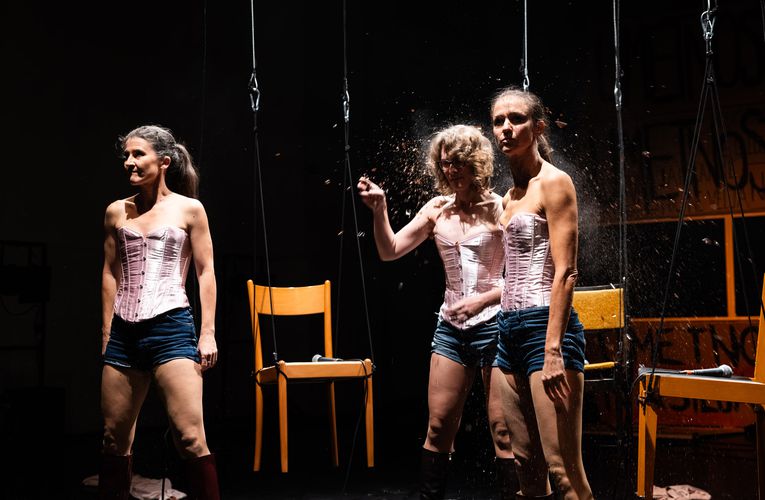
The Bukovec Sisters, a trio of cultural activists, make art they can take to the countryside, to the place of their origin. They try to push their cosmopolitan feminist performances into every Slovenian village, and, to their great surprise, the village accepts them with open arms and hearts full of life stories. And then weird things begin to happen. Nearby, a child finds a part of a woman’s hand in a pile of manure. Just like in a film. Reality interferes with the performance, and the Bukovec Sisters set off on a real mission. A mission against patriarchy, violence and femicide. They call their allies, neighbours, relatives, students. They put on pants, cut them. They grab their guns, occupy spaces in front of churches, schools and fire stations. They grab shovels, they dig graves. They stand in front of houses. Hold up their signs. Deploy into positions. Wave flags from the rooftops. They will no longer be silent. We will no longer be silent. The pile has finally spoken.
The Art of Living: The Act of Killing by Barbara Kukovec, Urška Brodar and Katarina Stegnar is a direct, documentary piece that uses the language of art in its concentrated form, filled with references to the authors’ previous work as well as the creativity of women artists who were instrumental for the development of feminist performative art, to talk about violence against women, misogyny and patriarchy while questioning if art can change things. And what, if anything, feminism in art did for the feminism of women* in the countryside, and whether art can help us change the power relations between genders. […] By showing patriarchy in the countryside, structural patriarchal violence in the workplace and in intimate partner relationships, and later addressing femicide, the production points to the injustices in the system and thus doesn’t remain silent. It does not perceive theatre as a space of relaxation and entertainment and at the same time points to the women artists who, throughout the history of feminism, also weren’t silent. The creators express their anger through the body that is subjected to binary categorisations, gender differences and social and societal demands, but they successfully avoid objectivisation and fetishisation, and the body appears as a constitutive component of their ego; through it they express their subjectivity and resist the dichotomy of body-soul in artistic creativity. […] By recognising what women have already done for feminism in the field of art, by looking at different aspects of patriarchy and by intertwining personal stories, own process of creation and the events from real life, the artists articulated things we prefer not to talk about, and this is why we don’t leave the theatre the way we were when we entered.
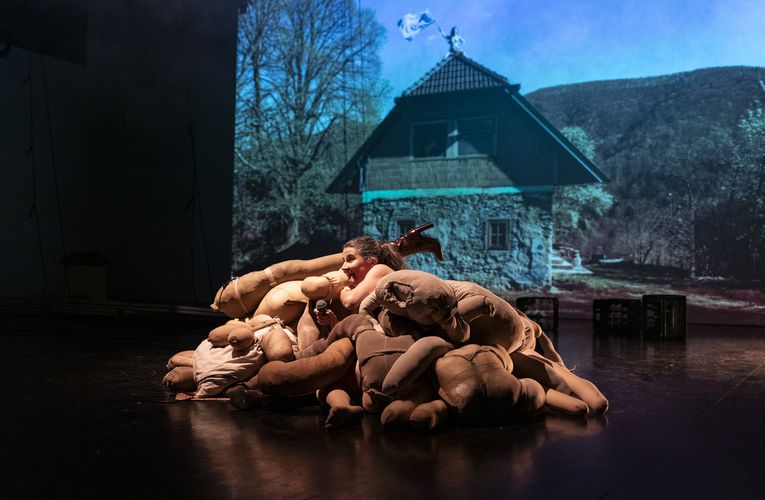
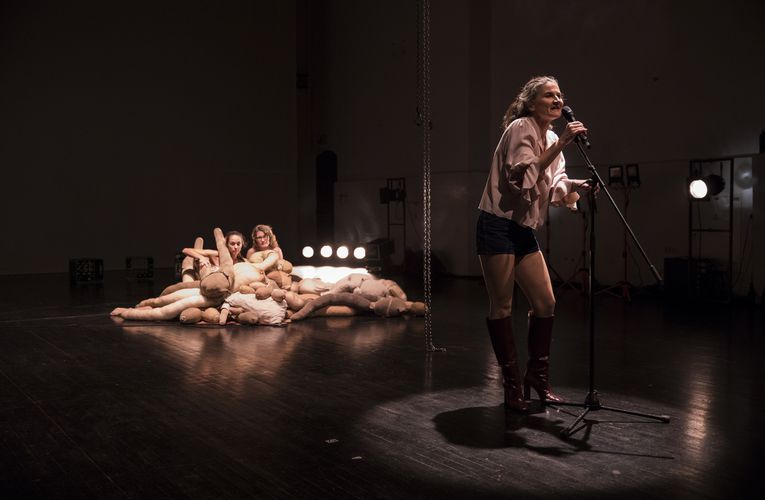
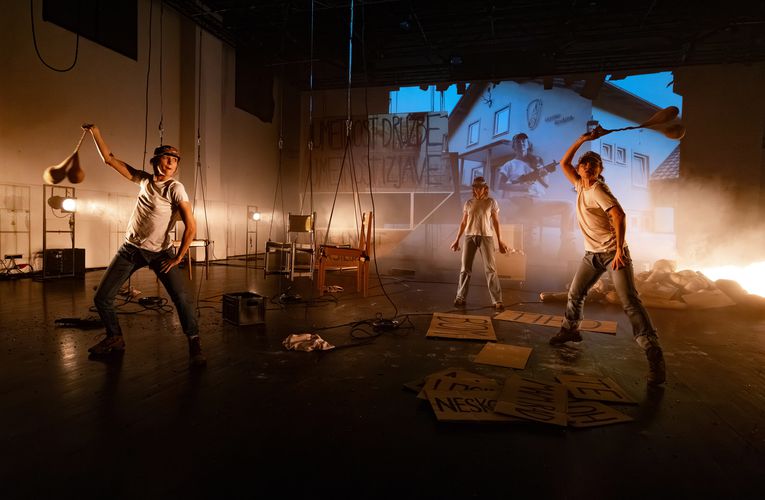
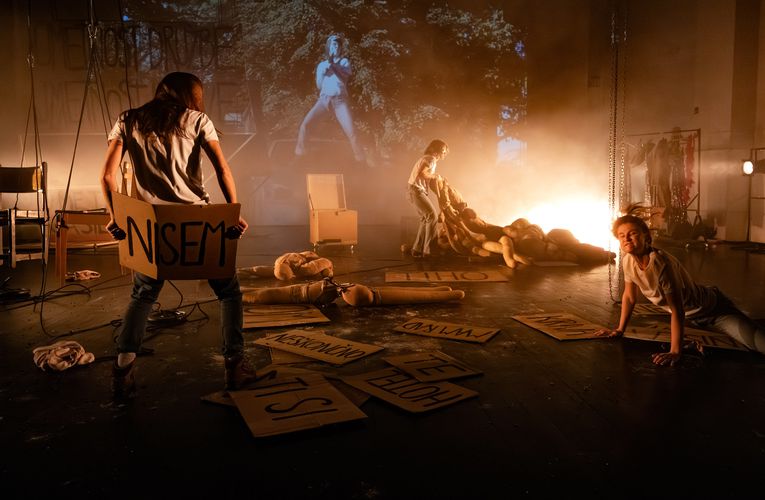
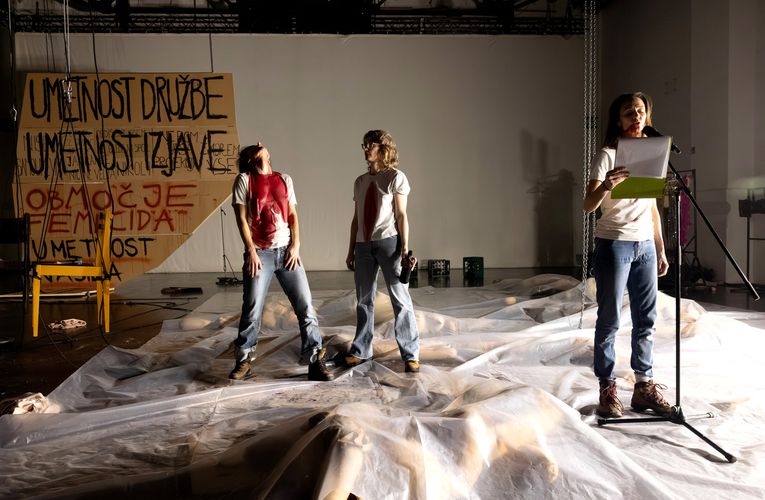
In the hall of Old Power Station [Kukovec, Stegnar, Brodar] greet us from the pile of fabric female bodies thrown together. Limbs are everywhere, as an immediate attempt at confronting the audience with violence that the performers had brought in their own bodies. The original inspiration lay in last year’s murder of a thirty-three-year-old woman near Kidričevo, in the immediate vicinity of Kukovec’s hometown and the spaces in which Sweet Worries empowered the local women. Nevertheless, a humorous tone leads us through the first part. […] [S]tronger [is] the next sequence of photographs in which the spectators are asked to express, using cardboard signs in front of their homes, what they wish for themselves. In silence, or accompanied by the sounds of a rooster, we can only observe the world of more intimate and political wishes and demands, and that seems to open a genuine space opens for them in within the performance. A parallel place is then opened by the performers when they speak about their experience of violence and slowly start reopening the themes that announced themselves in the beginning of the show. The segment feels particularly well structured and fresh because they highlight the experiences that according to some, particularly legal definitions wouldn’t immediately scream abuse. This triggers more contemplation in the spectator on the perception of violence, because she is not faced with clear-cut cases of severe sexual or physical abuse, but with microaggressions and pressure from those close to them. The production continues. In the manner of Valie Export and Marina Abramović, the Bukovec Sisters – as the performers named their trio – wearing trousers with zippers that reveal their genitalia and carrying plastic guns, attack the posters with the arguments that men usually use to excuse violence. In the background, we can see photos of Kukovec who, in front of different village homes, cars or fields, ironicises the image of a real man who loves his hunting rifle. […] A moment that seems slightly stronger is the one in which the performers toss into the audience fabric tits that fly across the hall like little balls. A simple action, which in today’s moment of oversaturation of brutal images wakes up the audience and turns on their channels of empathy more than any aggressive image could. […] And then the previously announced line of the performance opens, too. As the sign they unfold says, we’re entering the femicide zone. […] During the chronological inventory of the events, the performers, one by one, start choking on artificial blood that gushes from their mouth straight onto their white sleeveless shirts. The sound of gargling suffocation in the throat cuts deeply through the silence in the hall and efficiently triggers emotions and renewed empathic co-experiencing in the spectators. […] In the last shot, we follow the women who dig their own graves in the meadow, lie down in them and have themselves covered in soil by a digger. Parallelly, the performers in the hall hook the pile of fabric bodies onto a chain and pull it to the ceiling. In the context of the countryside, this alludes strongly to meat curing in some farm pantry, which adds to the chilling effect.
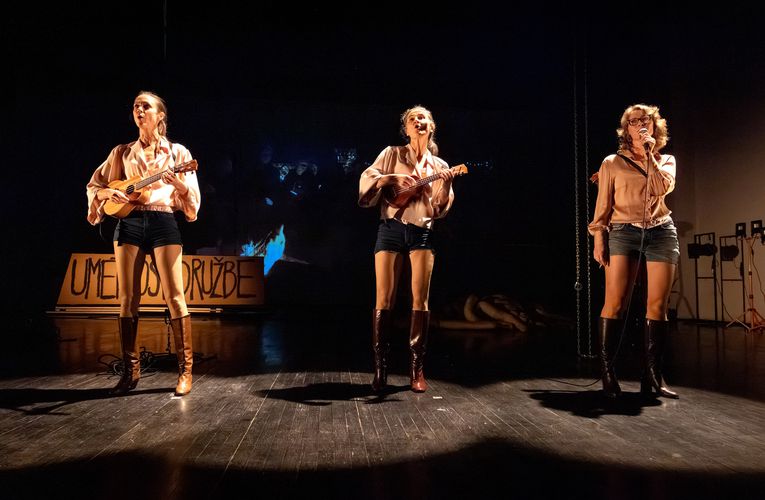
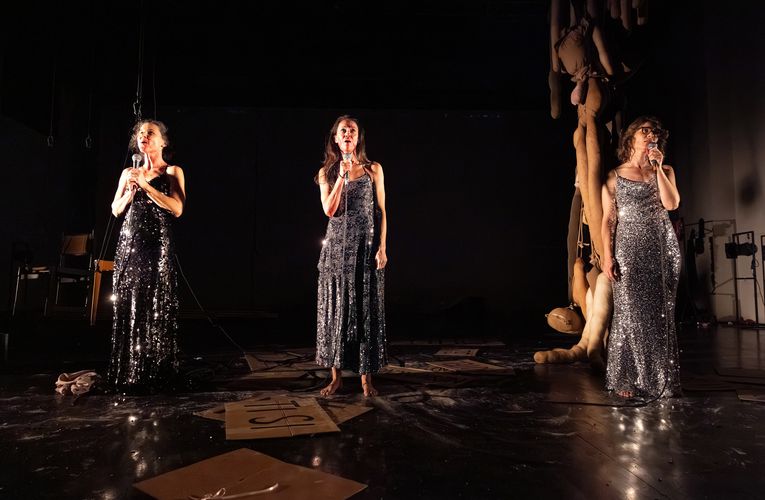
Just as the atmosphere in Sweet Worries is bittersweet, The Art of Living: The Act of Killing moves through similar emotional registers, except that the chain of scenes unfolds across a far more dynamic and expansive landscape. At first, there’s plenty of humour and laughter, warmth generated by viewing the videos documenting moments when 'art in the countryside' – the tour with Sweet Worries through the different locations of the southern Styria – created a small pocket for recognising one’s own experience and a discussion about it. Gradually, however, the atmosphere takes on a more melancholic tone, because besides the photographs of things (photographer Andrej Firm) that women want for themselves (for example, 'to go to the sea for the first time') it is becoming even clearer that one artistic intervention neither changed nor erased the deeply rooted patriarchy. Slowly, the initially pleasant and widely recognisable narrative about dichotomies of the move from the periphery to the 'centre', fills with a growing number of complex, and at times conflicting, affects. The material of the production, actually, constantly skips, shifts, constantly brings and deposits new and new layers, contents, procedures, images, statements and so on. It happens at each stop in the space – and each space has its own performing procedure; be it a music number by the Bukovec sisters, or commenting footage from visits to different places in Styria, or an 'installation' that wishes, with performative action, to evoke the indescribable horror of the femicide of a woman from Barbara’s village. In the end, there is a hanging structure made of soft props that symbolise the severed body parts – this scene is performed autonomously and in isolation, without explicitly establishing a relationship with other elements. While its form […] doesn’t offer classical completeness of either message or the ways it uses to express itself, it is genuine in its complexity, even though it reaches for the procedures of subversion, caricature and sarcasm (for example, the musical numbers by the fictitious Bukovec sisters that recreate hits with often misogynist or deeply patriarchal lyrics). It is an intense testimony of the fact that in front of us, we have an attempt to stage the topic of extreme violence against women, femicide, which has cut into the creative process of the project about contemporary art in the periphery.
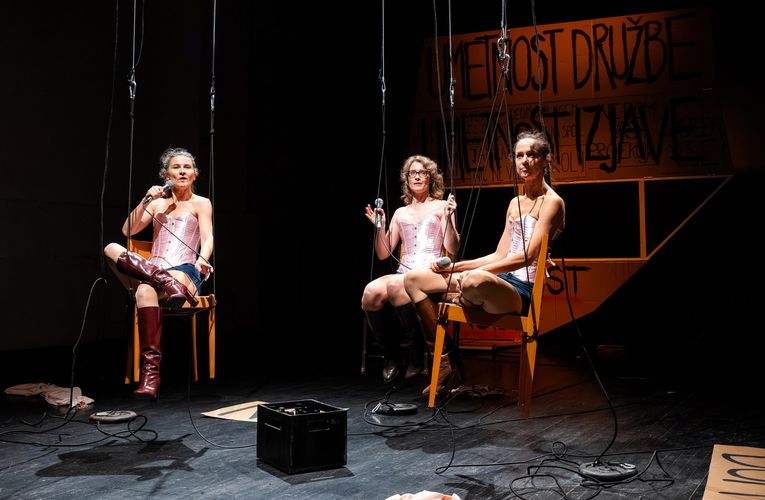
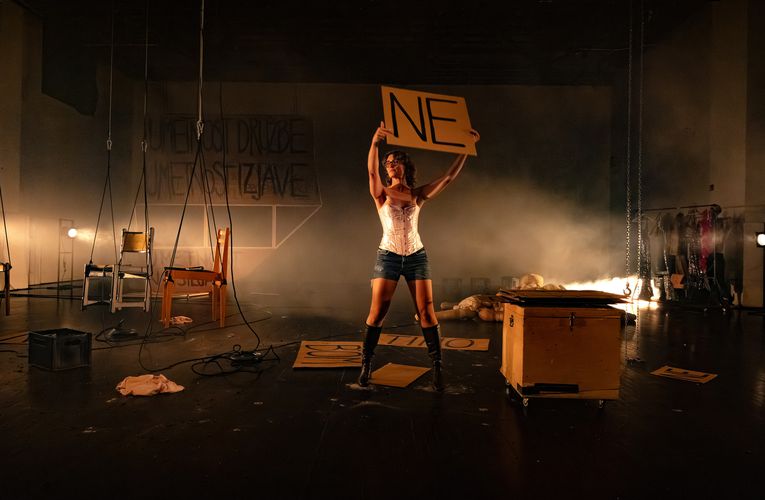
The performance does not focus on a single topic, rather addresses a range of issues that feminism deals with; from consensual sex and micro sexual violence to the femicide. The actresses take on the roles of the Bukovec sisters. [They] begin a story that starts lightly but ends on a heavy note. The Bukovec sisters wearing shorts and boots act as a kind of narrator, an ancient Greek chorus (but a female one) who use songs to comment ironically on reality. The protagonists don’t have clearly defined personalities, rather, they narrate themselves. The reality of the performance can be framed in several ways. The first frame and perspective we can follow is the rural one. Even though only one part of the play focuses directly on the countryside, the murder took place there, which makes the village present throughout the entire performance. And if not the village itself, then a kind of small-town atmosphere, something that even Ljubljana could represent. So this frame could be understood as something standing in opposition to a large urban metropolis. The second frame is, of course, feminist activism – the desire to educate and raise awareness – but also the feminism of the second wave, full of anger toward men. The last and, in my opinion, the most interesting interpretive frame is art itself. This frame appears in Barbara’s stories about escaping to the city, but also in her return to the countryside. The part about the murder is also presented as a form of art – described as an installation – which seems to express the need to confront patriarchy through art, just as the artists and performers Kukovec admired in London as she mentioned at the beggining of the perfromance. Art, in fact, seems to be a key word in the performance. As the play unfolds, the creators gradually reveal new inscriptions on a cardboard structure hanging from the wall: the art of society, the art of statements, and the art of violence. This is how the artists divided their performance. Interestingly, the final part about the murder is not called art, but the area of the murder […] We now enter the world of the art of violence, sexual and otherwise. Three actresses share their experiences, which many of the girls in the audience have likely encountered as well. These confessions form a transitional layer between the safe space of community and the act of murder. They slowly direct the audience’s attention toward the growing anger toward men and what they are capable of. The personal confessions also touch upon #MeToo issues in theatre – extremely important confessions about abusive directors who believe their position gives them unlimited power. I hope that such voices will continue to be heard more often, both in public debates and in the theatre. Soon after, violence becomes real on stage. Urška Brodar scatters boxes labeled 'no,' while two other performers enter armed and begin throwing plush breasts at the audience. The final part, as I mentioned, is no longer an art piece about violence, it becomes a crime scene, a representation of femicide: the intentional killings of women and girls motivated by gender-based reasons. The installation consists of plush, dismembered or deformed bodies covered with foil, accompanied by a performative retelling of a horrific story of the murder of a woman committed by her husband and his lover. This is an incredibly thought-provoking choice. Could it mean that performance art, rather than traditional theatre, is better equipped to speak about violence? Throughout these scenes, one feels the rage and sense of injustice radiating from the artists. Perhaps that is why this part feels so powerful and overshadows the rest of the performance, its honesty and rawness make the audience lose connection with earlier sections, as the core of the performance becomes the issue of femicide.
Jasna Podreka, Vesna Lovrec, Teja Kukovec Belšak, Katharina Hoerack, Dragana Alfirević, Monika Žnidarič, Renata Merc, Ajda Valcl, Barbara Polajnar, Irena Cigula, Vida Otič, Maja Pan, Irena Borić, Cvetanka Mileva, Tilen Kolar, Gregor Prah, Tibor Mihelič Syed, Sven Horvat, Rob Canning, Primož Bezjak, Damjan Ilić, Andreja Kovač, Goran Injac, Miha Kuhar, Uroš Kaurin, Marko Brumen, Miha Čelar, Matic Ačko, MKC MARIBOR, Ajda Fajfar, Ajda Marin, Lana Lovrenčič, Zoja Filip, Tia Horvat Veršič, Nika Ciglar, Thomas Kuehberger, Robert Rodošek, Danica Lorber, Darja Galun, Minka Markež, Adriana Zemljič, Vesna Kobale, Sara Korošec, Marija Fišer, Tatjana Fišer, Špela Fišer, Jožica Črnko, Silva Ilec, Zdenka Haladea, Ajda Fajfar, Vesna Mohorko Fajfar, Metka Majcen, Ajda Marin, Irena Kukovec, Janja Kafel, Marija Bezjak, Majda Fridl, Bronja Merc, Nina Kocman, Lana Strnad, Stanislav Vrtačnik.